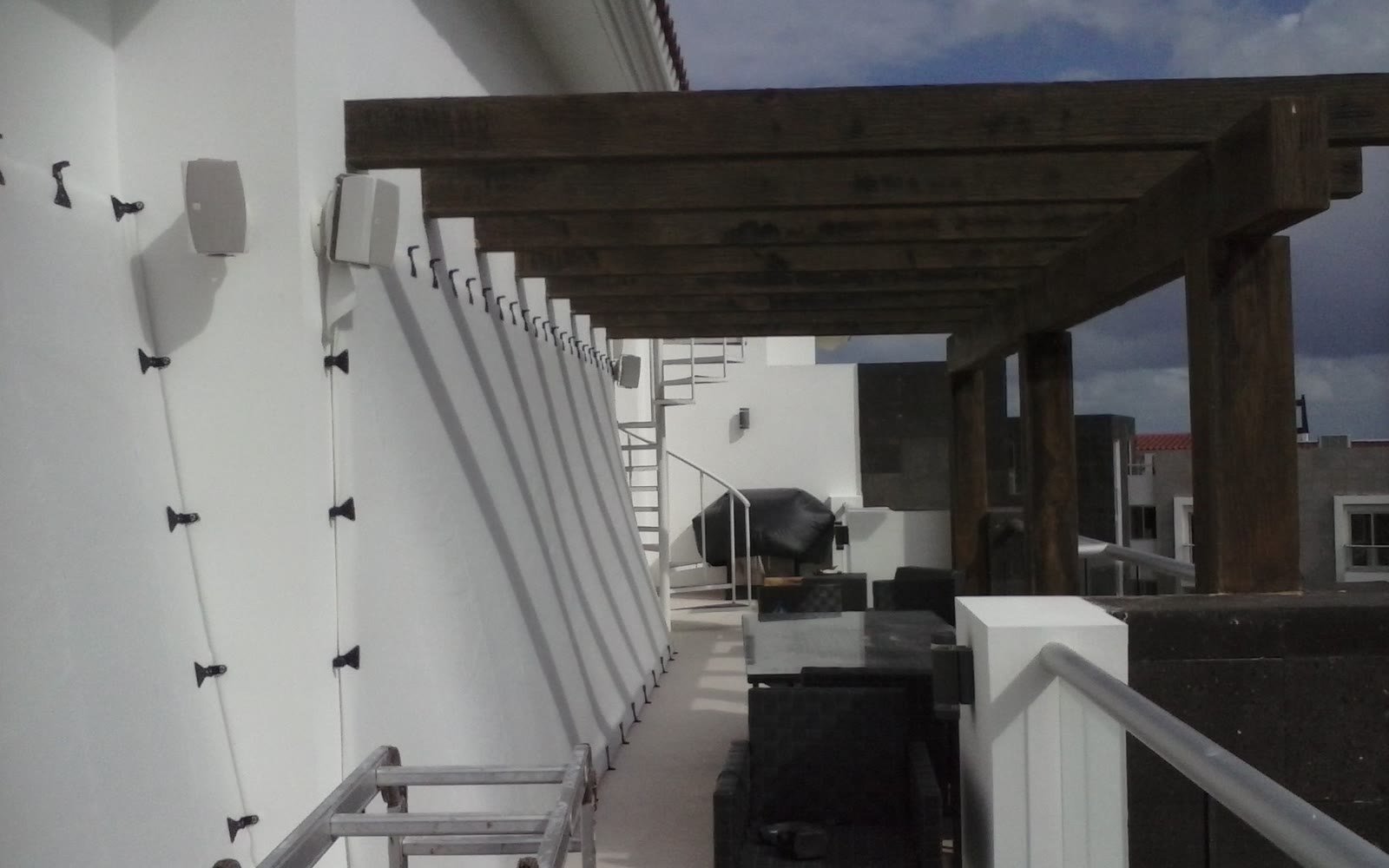
The terrace or open porch is often the largest opening on a coastal property, and the easiest one to underestimate. Protecting a terrace is not the same job as protecting a window. The surface area, the anchoring and the installation order all change. This guide covers what to check before you request a quote.
Think in total area, not in pieces
A 6-meter (20-foot) wide terrace has far more area to cover than a 1.2-meter (4-foot) window. The system is quoted per square meter of opening, and that basis is the same for both. What changes is the amount of fabric and anchoring involved. So don't compare "a terrace" with "a window" as if they were equal units. One large terrace and several small windows can represent the same investment if they add up to the same area.
The technical limit: maximum span between anchors
AstroFlex's certified engineering specifies a maximum span of 214 inches (about 5.4 meters) between fasteners. That is how far the system can reach before it needs an intermediate anchor point.
Past that span, you need added structural support or a different configuration, and sometimes case-specific engineering. On a large terrace, that can mean columns or intermediate supports built into the design, not just at the edges of the opening.
With a two-sided installation, the system anchors at both horizontal ends. The engineering then allows much wider openings without intermediate anchors, as long as the panel height stays within certified parameters.
Irregular and oversized terraces
L-shaped terraces, terraces with intermediate columns, and terraces with level changes need a different analysis than a rectangular opening. When you measure, break the space into simple rectangular sections. Send your provider a sketch or photos showing how the sections connect, and the quote can be accurate even before a site visit.
Take a terrace 8 meters wide and 3 meters tall, with a structural column at the 4-meter mark. The provider can treat it as two 4-meter sections and use the column as a natural intermediate anchor. That beats forcing a single 8-meter span that might exceed the certified limit.
If the terrace has several levels, irregular columns, or ties into a palapa or pergola, bring in a local architect or engineer who knows the property. A standard remote assessment may not go far enough.
What happens when a terrace stays unprotected
An open terrace is an entry point for wind-driven rain and wind-borne debris. It damages outdoor furniture, and it also hits the interior doors and windows that face the terrace, which were never built to take the exposure of an exterior facade. That secondary damage rarely enters the math when the largest opening gets postponed, and the repair can end up larger than the investment you meant to avoid.
Modular coverage, orientation and priorities
Besides continuous fabric, some terraces can be assessed with independent panels for each section. You can leave one access open while the rest stays protected, which helps if the terrace doubles as a service entrance, a social area and a pool deck.
Orientation matters too. On Mexico's coast, hurricane winds usually come from the sea toward land. A terrace facing the water takes a steadier, more direct load than a side terrace, which the building's own geometry partly shields. If you protect the property in stages, start with the one facing the prevailing wind. This is the classic oceanfront situation, covered in hurricane protection for beachfront homes.
Material and sun durability
A terrace exposes far more fabric to sun and moisture cycles than a window does. The woven polypropylene in systems like AstroFlex is designed to resist UV degradation. That matters as much as wind resistance, because fabric that breaks down early can lose some of its ability to slow an impact.
Multiple terraces and remodeling projects
If the property has more than one open space, such as an upper-floor balcony plus the main terrace, assess each one separately using the same area principle. Then ask for a joint quote in a single site visit, which can reveal efficiencies in material and labor. If you are also remodeling the flooring, built-in furniture or pergola, coordinate the two jobs so the permanent anchors go in during the same work, with no separate visit. To arrive with your data ready, read how to get an accurate quote for your property.
Quick comparison by opening type
| Opening type | What to check |
|---|---|
| Standard window | Smaller area; usually fits within a single span |
| Large terrace or porch | More fabric and anchoring; verify the maximum span |
| Irregular terrace | Split into rectangular sections; extra installation analysis |
| Terrace beyond the span | Columns as intermediate anchors, or added engineering |
| Terrace next to interior doors and windows | Risk of secondary damage if left unprotected |
| Terrace under remodel | Coordinate anchors with the construction work |
| Terrace facing the prevailing wind | High priority in a staged installation |
Measure the width and height of each opening, note the existing columns, and request a quote with photos or a sketch. An advisor reviews the layout and quotes by actual area, not by "terrace."
Frequently Asked Questions
Is there a size limit for protecting a terrace?
The system has a maximum span of 214 inches between anchors. Larger openings may need added support or intermediate anchor points.
Is the quoting basis the same for terraces and windows?
Yes. Both are quoted per square meter of opening. Only the total area changes.
Can I use an existing column as an anchor point?
In many cases, yes. Structural columns can serve as intermediate anchors and split the opening into manageable sections.
Can I protect only part of my terrace?
Some layouts allow modular coverage by section, depending on the design of each terrace.
Should I quote several terraces or balconies together?
Yes. A joint quote for all open spaces can reveal efficiencies that don't show up when each one is assessed alone.
Will the sun degrade the material on a large terrace?
The woven polypropylene in certified systems is designed to resist UV degradation, a key factor for openings with heavy sun exposure.