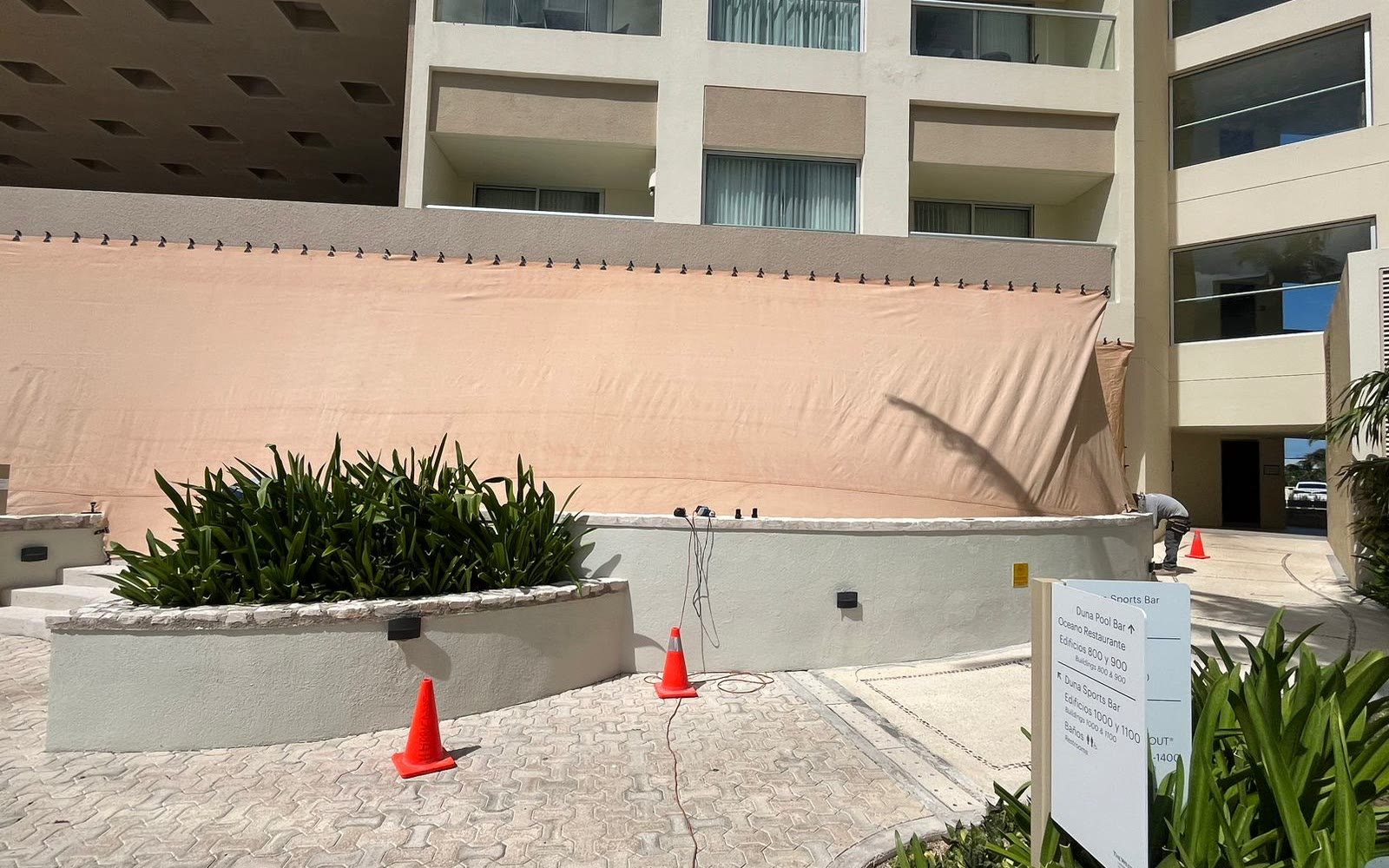
After a hurricane, owners tend to describe the damage in one short line: a window broke. That line hides the real bill. When an opening fails, wind and rain get inside, damage finishes, furniture, and equipment, and take the space out of use for days or weeks. Comparing a protection quote only against the price of new glass is an incomplete comparison—what matters is the value behind that opening, not the glass itself.
A Known Investment Against an Uncertain Loss
HFMexico has a clear reference price: from $1,995 MXN per square meter installed. That figure prices prevention before any threat exists. No one can promise that an unprotected home will suffer exactly $50,000, $200,000, or $1,000,000 MXN in damage in the next cyclone—that would mean inventing a probability out of too many variables.
Working with that uncertainty means thinking in scenarios, not a single figure:
- No direct impact: the loss is zero.
- Strong wind and one opening fails, causing limited interior damage.
- The opening fails and heavy rain follows for hours, raising the damage.
Protection does not change whether the hurricane happens; it changes part of the vulnerability in each scenario.
What Opening Protection Actually Protects
The Florida Hurricane Retrofit Guide explains that a broken window or door lets wind and water inside, and that protecting openings cuts the risk tied to debris and rising internal pressure. FEMA's P-804 guidance treats the building envelope—roof, walls, doors, and windows together—as the core of wind mitigation.
Do not oversell the scope. A system over your openings will not reinforce a weak roof, stop storm-surge flooding, or replace a structurally deficient garage door. Its job is specific: keep openings protected against impact and documented design conditions.
The Real Value Sits Behind the Window, Not in the Glass
Take a sliding door measuring 3.0 by 2.2 meters (roughly 10 by 7 feet): 6.6 m² (about 71 sq ft). At $1,995 MXN/m², the protection reference runs $13,167 MXN. Behind it sits a sofa, a table, a television, curtains, flooring, and walls—no need to invent a damage figure to see that the value at risk can run several times the cost of covering that one opening.
On a Vacation Rental Property
The loss does not end once repairs are paid. An unusable unit means lost sellable nights, relocated guests, and possible cancellations or bad reviews—costs tied to occupancy, rate, and season, so calculate them with your property's real numbers.
On Water-Sensitive Finishes
Natural wood, MDF, laminate flooring, upholstered furniture, and electronics take disproportionate water damage once humidity combines with a power outage. No impact protection should be sold as full waterproofing: water can still enter through joints, the roof, or other points. Its real value is closing one major entry path, not promising a dry interior.
Why Certification Changes the Comparison
Approval file FL15186-R7 documents, for the HFMexico system, a design pressure of +80/-80 PSF and impact resistance within its approval, evaluated by a licensed Florida engineer. That evidence will not calculate how many pesos of damage it prevents in Mexico, but it separates an investment with verifiable specifications from a solution whose performance cannot be checked.
A mitigation measure without evidence carries a financial problem: you cannot tell what you are buying. Technical documentation cuts that uncertainty—worth checking HF México's pricing page before comparing a certified system with an improvised barrier.
Time Costs Money Too
After a cyclone, hundreds of properties need the same contractors at the same time: glaziers, carpenters, electricians, painters, and drying crews all face high demand. Even with insurance in place, a payout does not rebuild anything instantly. CENAPRED's México Preparado portal emphasizes official monitoring and preparedness through the 2026 season.
The practical takeaway is simple: protection decisions should be finished before an impact warning goes out, while contractors and logistics still operate under normal conditions.
Insurance Does Not Replace Mitigation
An insured owner may assume repairs become "the insurance company's problem." In practice, a policy and physical protection do different jobs: insurance spreads part of the cost after the event, subject to deductibles, coinsurance, contents limits, and adjustment timelines; mitigation reduces a vulnerability before the event happens.
Policy conditions vary widely in Mexico, so this article does not attribute any discount or automatic coverage to the HFMexico system: some insurers do recognize installed protection, but results depend on each policy. Even with a covered loss, there is a deductible, uncovered expenses, and weeks without use.
Protecting vs. Repairing Afterward
Here is how the two paths compare. As a scale reference, 10 m² (about 108 sq ft) runs $19,950 MXN; 20 m², $39,900; 30 m², $59,850; 40 m², $79,800 MXN, before project-specific conditions.
| Variable | Installing Protection | Repairing Afterward |
|---|---|---|
| Cost | Known and budgetable, from $1,995 MXN/m² | Uncertain; depends on the event and the damage |
| Timing | Before the season | After the impact |
| Goal | Reduce opening vulnerability | Restore what already failed |
| Contractor availability | Normal with advance planning | Can tighten after an event |
| Loss of use | Aims to lower the odds of opening-related damage | Can force closure or unlivability |
| Certification | Can be verified before you buy | Does not change the fact that damage already happened |
To price your own openings, HF México's quote request starts from your property's real measurements.
Building Your Own Cost-Benefit Analysis
No national figure describes your house. The exercise that works has four steps:
- Measure your exposure: every opening and what sits behind it—finishes, furniture, equipment, room use.
- Price the investment: multiply the area by $1,995 MXN/m² and confirm against a real project.
- Model low, medium, and high damage scenarios without inventing probabilities.
- Prioritize by consequence: largest or highest-value openings first, full coverage as the goal.
Repairing afterward can cost little in a minor event or a lot in a severe one; that uncertainty is the problem. Installing protection turns part of that risk into a known, planned investment. More cost guides are on the HF México blog.
Frequently Asked Questions
How much does HFMexico cost per square meter?
From $1,995 MXN per square meter installed, as a 2026 reference.
How much does it cost to repair a house after a hurricane?
There is no universal figure: it depends on the type of damage, the property's size, water, finishes, labor, and loss of use.
Should I compare protection only to the price of glass?
No. It includes interiors, cleanup, drying, furniture, equipment, and possible loss of use.
Does protection stop all water from getting in?
No. It reduces one vulnerability tied to openings; water can enter elsewhere, and storm surge or flooding call for different strategies.
Does insurance replace protection?
No. Insurance transfers part of the financial risk after the event; mitigation aims to reduce the probability or severity of physical damage before it happens.
How do I prioritize if I cannot protect everything at once?
Start with openings that are large, exposed, or hold the highest interior value, with covering the full set as the goal.