The Price of a Sheet Isn't the Price of Protecting a Home
A sheet of plywood is easy to buy—you just pick it up, piece by piece. A home isn't protected by buying sheets, though. It's protected by turning every opening into a system that works before a storm. That means measuring, cutting, prepping anchors, labeling each panel, storing everything somewhere dry, and having an installation sequence that holds up once a warning goes out. On a house with ten or twenty openings, material is just the first line of a much longer bill.
HF México's reference price is transparent: from $1,995 MXN/m² installed. For 20 m² (about 215 sq ft) of openings, that's $39,900 MXN. Wood almost always costs less upfront, but a fair comparison adds everything an owner repeats every season: cutting, hardware, labeling, dry storage, transport, installation labor, and replacing warped panels.
What FEMA Says About Temporary Wood Panels
FEMA's P-804 guide recognizes structural wood panels as valid temporary protection, but it documents the trade-offs: they must be installed and removed every time, need proper dry storage to avoid warping, and can be difficult to mount on upper floors. None of that means wood "doesn't work." A well-designed panel, with the right thickness and anchoring, can be part of a reasonable strategy. The problem is treating any board nailed up at the last minute as equivalent to a tested product. Real performance depends on the panel, fastener spacing, the substrate, and the material's condition.
Three Scenarios That Change the Math
The real cost of wood depends on who installs it and under what conditions:
- Owner on-site, ground floor: with few openings and the owner available, labor costs next to nothing. But that saving depends on the owner being there. Travel, injury, or missing the window before roads close turns "cheap" into protection sitting in storage during impact—worth nothing.
- Second home or rental property: someone has to locate the panels, transport them, match each piece to its opening, and fasten it in time. With multiple properties, that workload multiplies into overtime, fees, or the risk that installation doesn't finish before impact.
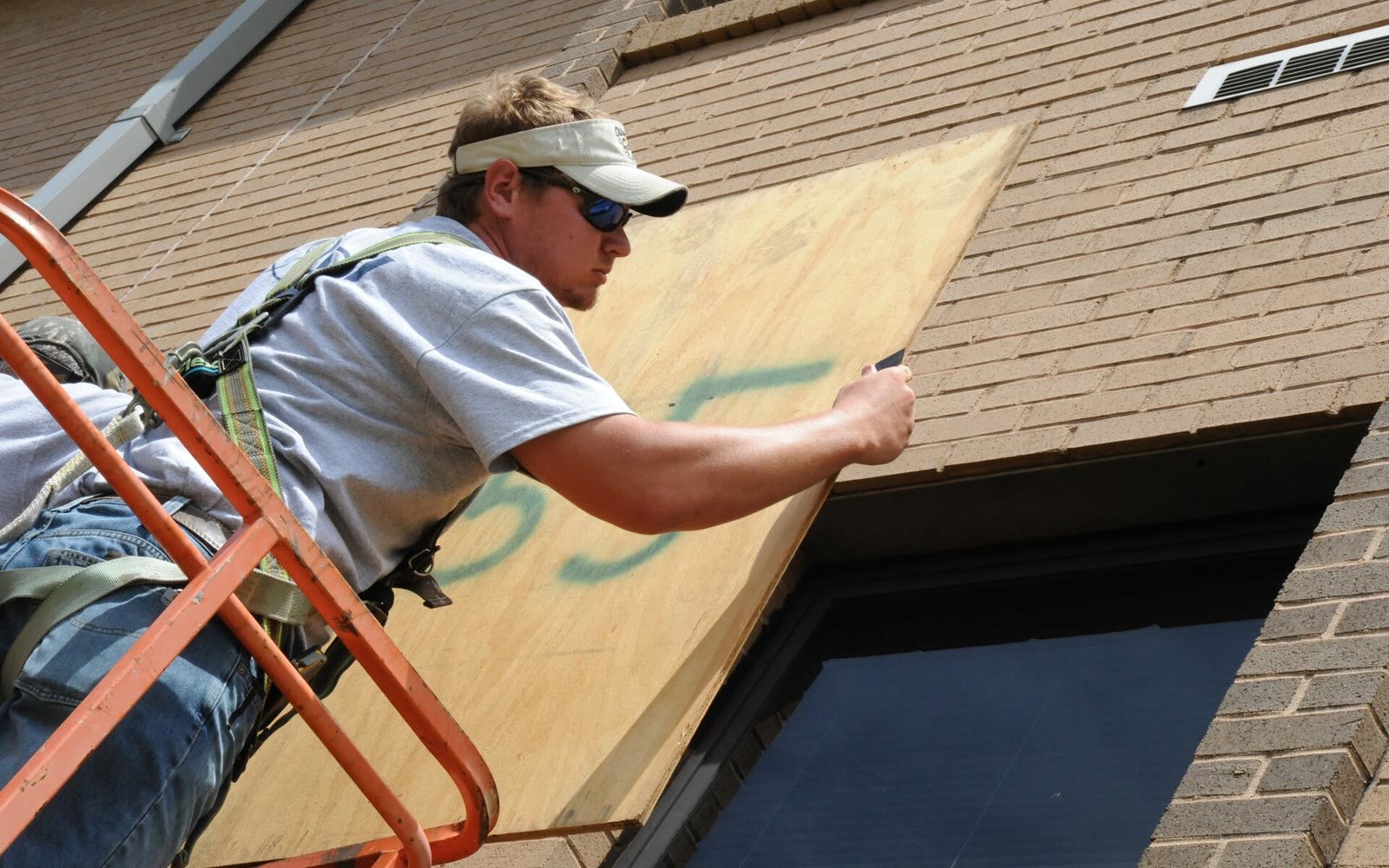
- Second-floor windows: handling plywood on a ladder in rising wind is nothing like ground level. FEMA flags exactly this: temporary systems can be hard to mount on upper floors, sometimes requiring scaffolding or two people per panel.
That's why price needs to be judged opening by opening and by how accessible each one is, not just by what the sheet costs at the hardware store.
Certification and Technical Evidence: What You're Actually Paying For
HF México's system is backed by Florida Building Code approval FL15186-R7, with a documented design pressure of +80/-80 PSF and evaluation by a licensed Florida engineer. That doesn't mean a Mexican home is automatically approved under a US code—it means the product has an independently verifiable technical basis, the same one behind HF México's systems. There's also a documented limit: the system isn't approved for High-Velocity Hurricane Zones (HVHZ).
A sheet of wood cut on-site doesn't come with an equivalent evaluation by default; that has to be demonstrated case by case. If two options offer the same evidence, the price gap is real. If not, you're comparing two different scopes.
The Five-Year Cost, Not the First-Day Cost
Coastal humidity and poor storage can warp wood panels. Once that happens, quick installation gets harder and pieces need replacing, sometimes after just one or two seasons. Total cost of ownership has to add up those replacements, hardware, storage, transport, and labor over several years, not just the initial outlay. As a reference, starting from $1,995 MXN/m² installed: 10 m² runs $19,950 MXN; 20 m², $39,900 MXN; 30 m², $59,850 MXN; 40 m², $79,800 MXN. There's no "average" wood price for Mexico here, because it swings too much by species, thickness, grade, and season, and making one up would just create false precision.
| Criterion | HF México | Wood panels |
|---|---|---|
| Upfront cost | From $1,995 MXN/m² installed | Usually lower for materials; needs a real quote |
| Technical evidence | FL15186-R7; ±80 PSF | Depends on design, thickness, anchoring, and execution |
| Pre-storm installation | Removable-system deployment | Panel-by-panel mounting |
| Storage | Organized removable system | Needs dry, flat storage space |
| Service life | Depends on care and inspection | Can shorten from moisture, warping, or damage |
| Upper floors | Access needs evaluation | Can be difficult and heavy |
| 5-year cost | Upfront price plus care/operation | Material plus repeat labor plus possible replacements |
Don't Wait Until the Storm Is Close
Mexico's Servicio Meteorológico Nacional runs the official monitoring for the 2026 tropical cyclone season. Buying wood once a threatening system exists depends on sheets, hardware, tools, transport, and installers all being available at once, with no room to fix mistakes. Prepping panels months ahead cuts that risk, but then the owner carries inventory and storage year-round. HF México's quote page exists to move that decision out of the emergency window: measure the property and know the cost ahead of time, instead of deciding under pressure with a storm already on the radar.
The Decision, in One Question
If you could only do one thing, price out five years instead of day one: material, installation, storage, labor per deployment, replacements, and the real odds the system goes up in time. That exercise usually shows cheap and economical aren't the same thing. Wood still holds up in specific cases—single-story, owner on-site, few openings—but treating it as equivalent to a certified system without weighing design, anchoring, and operation is the mistake that costs the most, and it shows up after the hurricane, not before. More protection comparisons live on HF México's blog.
Frequently Asked Questions
Which is cheaper, HF México or wood panels?
On material alone, wood is usually cheaper. HF México starts from $1,995 MXN/m² installed; the full comparison adds hardware, prep, storage, repeat installation, and replacing worn wood.
Does wood actually protect against hurricanes?
It can be part of temporary protection if the panel, thickness, anchoring, and installation are well designed. Not every board nailed up haphazardly equals a tested system.
Why does FEMA list downsides for wood panels?
Because temporary panels have to be installed and removed every time, need proper storage, and can warp; mounting them on upper floors can also be difficult.
What does 20 m² cost with HF México?
$39,900 MXN as a reference figure from $1,995 MXN/m² installed, before project-specific conditions.
Does HF México eliminate every hurricane risk?
No. Opening protection is one layer of mitigation. Roofing, water intrusion, storm surge, drainage, and an emergency plan all matter too.
What's the better choice for a second home?
Prioritize a solution a property manager can deploy repeatably and safely. On a rental property, logistics and staff availability outweigh whatever you'd save on material.