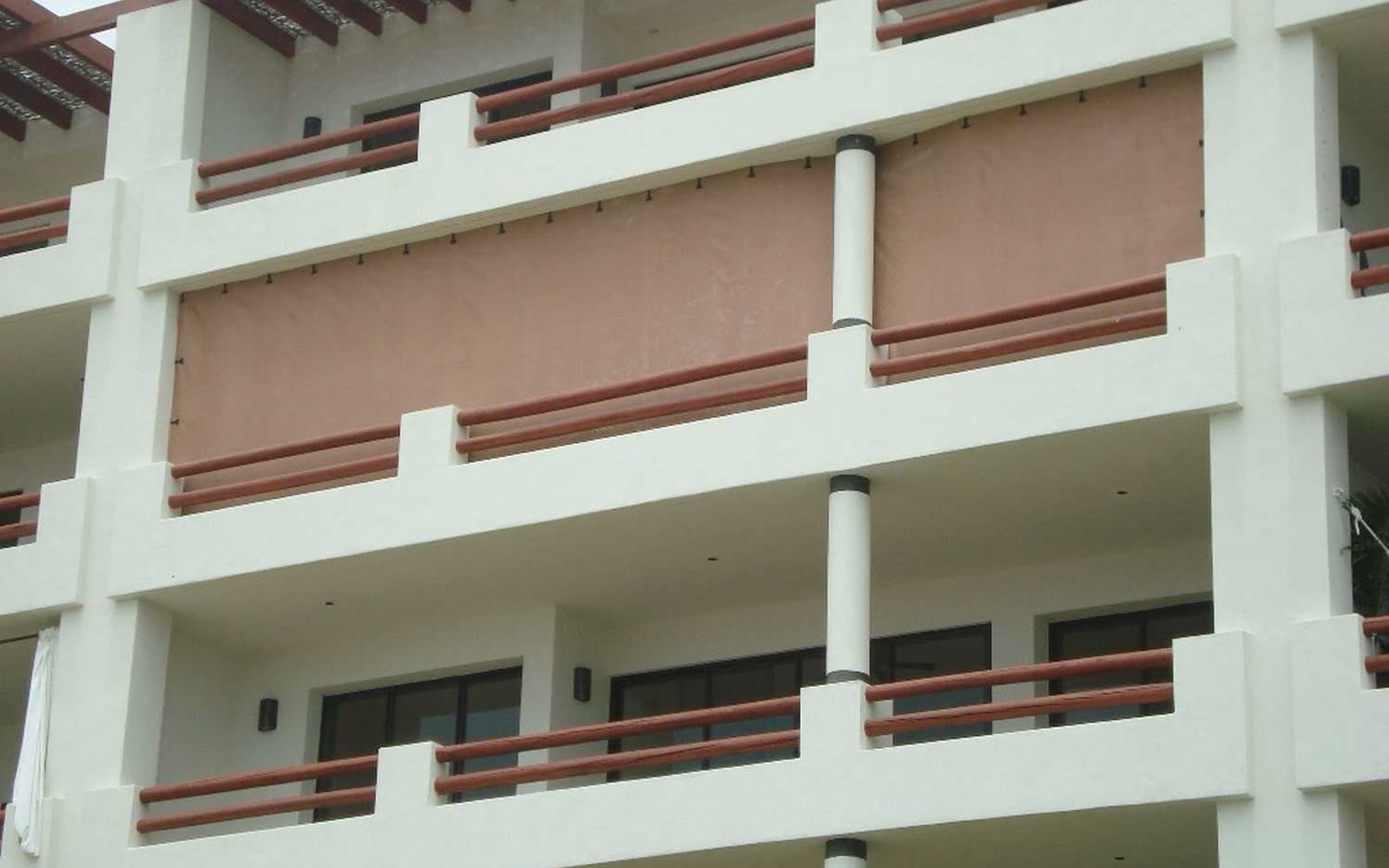
What Counts as an "Opening" (and Why House Size Isn't the Number That Matters)
Windows, doors, sliding glass doors, and any glazed access point make up your home's building envelope—the points where hurricane wind and debris can get inside. The most common budgeting mistake is counting units instead of area: ten small windows can add up to less square footage than two large sliding doors. Because HFMexico prices its polypropylene hurricane fabric system per square meter installed—starting at $1,995 MXN in 2026—the actual opening area, not the house's built square footage, is what drives the quote. That's why two similarly sized homes can end up with very different prices.
How to Inventory Your Windows and Doors in an Hour
Walk the house facade by facade, not room by room, and code each opening (F1-W1 for facade 1, window 1). Record width, height, floor level, type, and a photo to avoid duplicates and speed up the review later. For a preliminary estimate, multiply width by height: a 1.5 × 1.2 m (about 5 × 4 ft) window covers 1.8 m² (about 19 sq ft), and a 3.0 × 2.2 m sliding door covers 6.6 m². Four windows that size plus one sliding door add up to 13.8 m²—roughly $27,531 MXN at $1,995 MXN per square meter.
Measure to Budget, Not to Install
A tape measure and photos are enough for a preliminary budget—that's just width times height per opening. Installation measurements differ: surrounding surface, edges, obstructions, and substrate—best confirmed on a site visit. Note protruding frames, railings, blinds, or trim in your photos so the quote flags special cases early.
Why No Facade Should Be Left Out
A common myth is protecting only the ocean-facing side. Hurricane winds shift direction as the storm moves, and debris—roof tiles, branches, loose objects—can hit from unexpected directions. Wind and debris are the primary hazards the National Hurricane Center identifies with hurricanes. Installation priority can flex with the budget, but the inventory should cover all four facades; none gets skipped without a technical reason. Companies like HF México design their projects around exactly that full-envelope logic.
Sliding Doors, Front Doors, and Garage Doors
Sliding glass doors usually account for the largest share of square footage in a coastal home: a single 4.5 × 2.4 m unit covers 10.8 m², around $21,546 MXN. That's why quoting "by number of windows" can mislead—two houses with fifteen openings each can differ enormously if one has floor-to-ceiling glass. A solid front door needs a different evaluation than a glass one, and a garage door is its own category: its strength depends on specific structural reinforcement. A system built for windows doesn't replace that reinforcement, so log it in the inventory even if the final solution differs.
Second-Floor Openings and Phased Protection
Mathematically, 2 m² upstairs is still 2 m², but installing and deploying protection there usually needs different access—ask upfront who will do it and how. If budget forces you to phase the project, protect the largest, most exposed glazed areas first and set a timeline for the rest. Example: on a 32 m² total ($63,840 MXN reference), covering 18 m² in year one accounts for $35,910 MXN and leaves 14 m² still to schedule. Partial protection isn't a fully protected house—label it that way with your provider.
What Else Changes the Final Quote
Price per square meter is the baseline, not the whole story. A few other factors move the project:
- Wall type and substrate
- Edge distances and irregular geometry
- Height and access for installation
- Obstructions and anchor configuration
Approval file FL15186-R7 documents that HFMexico's system carries a design pressure of +80/-80 PSF and specific use limits; a serious quote respects those limits instead of applying a flat rate to every opening. Turn your inventory into a formal quote with the HF México quote tool.
Budgeting Methods: What Each One Gets Right and Wrong
| Method | Advantage | Drawback |
|---|---|---|
| By built square meters | Fast | Doesn't reflect how many openings exist |
| By window count | Easy to tally | Ignores huge size differences |
| By opening area | Ties price to real surface area | Requires measuring |
| By technical survey | Most accurate | Needs a professional site visit |
From Inventory to Deployment Plan
Once every opening is identified, the next step is operational: each panel needs a storage spot, an ID, and an installation sequence, so the owner, or whoever represents them while they're away, knows where each piece lives and how long it takes to put up. In a condo or managed property, that list becomes a maintenance checklist. Before you sign off on a budget, compare it against your photos and check for small bathroom windows, side entrances, or openings hidden behind furniture and landscaping—the ones that quietly get left out.
Frequently Asked Questions
How much does it cost to protect 20 m² of openings?
About $39,900 MXN as a reference, based on HFMexico's 2026 rate of $1,995 MXN per square meter installed.
Should I calculate cost from my house's built square footage?
No. Built square footage is just context; price depends on the real area of windows and doors you're protecting.
Do sliding doors count the same as windows?
Yes, and they usually weigh more in the total—one large sliding door can add more square meters than several windows combined.
Do I need to protect the facade that doesn't face the ocean?
Yes. Hurricane wind and debris can come from any direction, so no facade gets ruled out without a technical reason.
Can I protect my house in phases if the budget is tight?
Yes, but keep the full inventory from the start so you know what's still pending and don't mistake phase one for the complete solution.
Does a garage door fit into the same per-square-meter math?
It goes in the inventory, but its strength depends on its own structural reinforcement—a window system doesn't substitute for that.