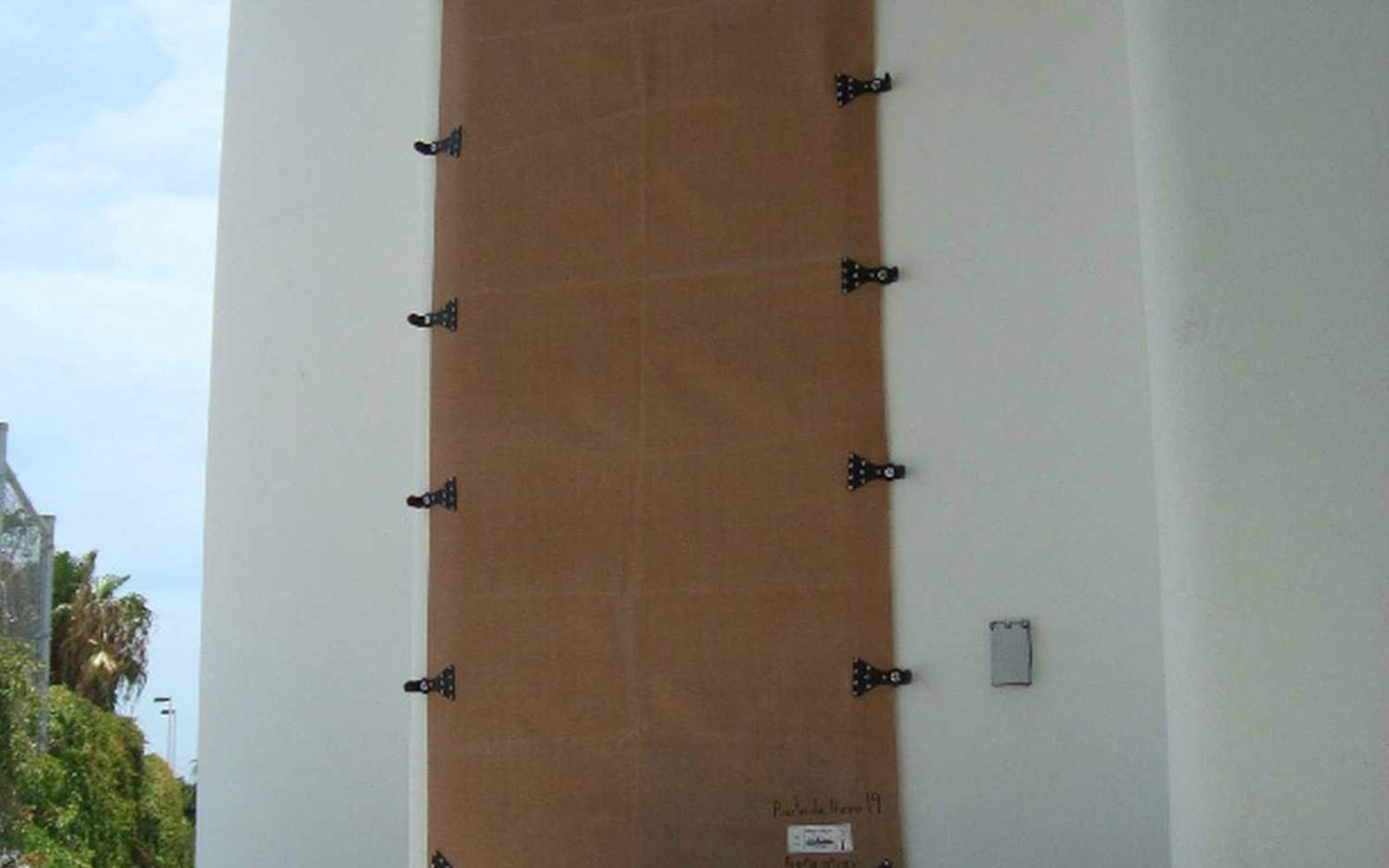
When you compare hurricane protection systems, most people talk about PSF ratings and materials. Few explain where the fabric actually attaches to the structure. On AstroFlex, woven polypropylene hurricane fabric is held by a patented clip with a built-in spring effect. This guide covers how it works, what documentation backs it, and what to ask any supplier.
The key idea: the AstroFlex clip doesn't resist impact in a fully rigid way. It lets the screen slow a moving object in a controlled manner, and that engineering difference is recorded in the system's certified drawings.
Rigid Anchoring vs. Spring-Action Anchoring
Many systems use completely fixed anchor points. The material is clamped in place and has no room to move when something hits it. The AstroFlex clip adds controlled flexibility at exactly that point.
Flexible doesn't mean weaker. The impact energy is spread differently: the screen slows the flying object instead of sending the whole blow into one rigid point. It's the same physics as a car bumper or an industrial shock absorber. An impact absorbed gradually produces a lower peak force at the anchor than the same impact hitting a structure with no give.
Why It Matters in a Hurricane
Wind-borne debris, branches, and loose materials strike protection at very different speeds and angles. A system that decelerates the impact is built to handle that variability. That's the logic behind the Large Missile Impact test in the TAS 201 protocol.
In the documented AstroFlex test, a 9-pound (4 kg) 2x4 wooden missile was fired at roughly 50 feet per second (15 m/s). The system absorbed the hit through controlled deflection of the fabric and clip, with no structural failure. Results appear in the Fenestration Testing Laboratory, Inc. report (certificate 08-0313.01).
The Documentation Behind the Design
This mechanism isn't an unsupported marketing claim. It appears in the system's sealed engineering drawings (upper and lower mounting clip details, drawing FL15186-R7 by MEA Engineers, Inc.) as part of AstroFlex's product approval. The engineering is sealed by John H. Kampmann Jr., PE, Florida License No. 47516.
The drawings specify the clip's dimensions, tolerances, and materials. That lets you verify that a real installation uses components identical to those lab-tested, closing the loop between what was tested and what ends up on your property.
Fabric and Clip Are Certified as One System
The deceleration effect depends on the clip working together with the panel, which on AstroFlex is woven polypropylene. Both were tested as a single integrated system. Swapping the fabric for another one without retesting the whole assembly voids the original certification, even if the clip stays the same.
Consistent Manufacturing: The Detail Almost Nobody Discusses
The clip is made to exact dimensional specifications with defined tolerances, so every unit performs like the ones that were tested. An excellent design loses its value if production parts don't match what was certified. That consistency matters as much as the design itself, yet it rarely shows up in a surface-level comparison.
Because the design spreads impact energy, it also lowers the chance of damage concentrated at one anchor point. After a moderate event, you may need to replace fewer individual anchors than with a rigid system, where all the force lands on the fastener.
Clip Maintenance
With fewer moving parts than a motorized system, the clip usually needs minimal upkeep: a periodic visual check for corrosion, deformation, or wear, especially near the coast where humidity and salt air are heavier. It needs no lubrication and no regular mechanical adjustment. Over the long run, that's an advantage over more complex mechanisms.
How to Compare Other Manufacturers' Anchoring
Beyond the headline PSF rating, ask any supplier these questions:
- Is your anchor rigid, or does it include an impact-deceleration element?
- How many load cycles was it tested for?
- What service life do you expect from the component under normal use?
- What maintenance does it need over time?
- Are there sealed drawings and lab reports to back it up?
For more on what to ask before you decide, read the key questions to ask before hiring hurricane protection. Base your decision on verifiable documentation, not on how persuasive a sales pitch sounds. Once you know which system interests you, request a quote and an advisor will prepare it for your property.
Anchoring Comparison
| Aspect | What it means |
|---|---|
| Fixed rigid anchor | Resists impact with no flexibility at the anchor point |
| Spring-action clip (AstroFlex) | Decelerates impact in a controlled way, documented in sealed engineering |
| Documented manufacturing consistency | Determines whether lab-certified performance carries over to every installed unit |
| System tested as a whole (fabric + clip) | Changing one component on its own voids the full certification |
| Questions about load cycles and service life | Allow a more rigorous comparison than PSF and general design alone |
Frequently Asked Questions
Does the flexible clip make the system weaker?
No. Controlled flexibility is part of the design for slowing impacts, not a structural weakness.
Can I see the engineering documentation?
Yes. It's in the sealed engineering drawings that form part of product approval FL15186.
Do I need to lubricate or adjust the clip?
No. A periodic visual inspection is enough; it needs no regular mechanical maintenance.
How do you ensure every clip matches the one tested in the lab?
Through the dimensional specifications and tolerances in the engineering drawings, which govern manufacturing.
Can I use the clip with a different fabric?
Not without voiding the certification. The system was tested as a fabric-and-clip assembly, not as interchangeable parts.
How do I know if another system's anchor is rigid?
Ask the manufacturer directly how the anchoring mechanism is designed, not just what the overall PSF rating is.